Thursday, March 26, 2009

Disappearing Act

Somewhat like me regarding this blog, my research subjects are also pulling a disappearing act...

I've spent this week -- "spring break" as it were -- at the Oregon State University Hermiston Agricultural Research and Experiment Center in northeastern OR. Other than plaguing my advisors with questions out here, I am processing 54 crayfish (Pacifasticus leniusculus) that I collected along the Umatilla River late last summer just after moving to Oregon. My task with the tasty crustaceans this week: digesting. Acid digesting. It sounds so much more benign than what it is: the dissolving of dried flesh in concentrated, heated acids. Creepy, yes. And not just because I'm perpetually afraid of getting burnt.


In a magic elixir of nitric acid, hydrogen peroxide and hydrochloric acid,
these crayfish dissolved in less than three hours.


The purpose of doing this: trace metal analysis. The pure liquid sample of dissolved cray body can be "read" for dissolved metals by running it through a large, expensive machine that I don't yet understand (ICP-MS). I'll measure levels of lead, cadmium, zinc, iron, and copper in each sacrificial, cute crustacean.

I know, I know. I'm an entomologist!! At the very least, a burgeoning ecologist... How did I wind up with a toxicological project? I dunno. There are a lot of scientists who start out elsewhere and somehow wind up as entomologists, so maybe it's the universe trying to balance itself. But I won't go willingly into toxicology. While the crays are a required part of my graduate research, as per my funding source, I'm still hopeful funds will be found for me to incorporate at least ONE insect genus. Hopefully my grant writing will produce, but no luck so far there. Meantime, I go aquatic insect collecting to cheer myself up, and I'm trying not to think about graduating with a MS thesis on freshwater crustaceans (wondering who'll hire me as an "entomologist"). Admittedly, there are worse things to stew over these days than the fate of one's career now aren't there? At least I am in graduate school...

Me collecting aquatic insects along the Salt River
(3.01.09, McCredie Hot Springs, Oregon)
Photo by Yvan Alleau

Monday, March 16, 2009

Thrush Magic

"Cheese n rice, you are a spectacularly majestic bird!"
These are the words that escape me each time I view this:

The Varied Thrush. The brilliant orange-against-black of
this, my most favorite of winter birds, rivals our
occasional sun breaks.
Photo used with permission by Mike Yip http://vancouverislandbirds.com


It has been some time since I've seen this bird -- mainly because I've been living in the Sonoran Desert for the last five years. Now back in the Pacific NW, I am treated to the awesomeness of the Varied Thrush whenever I choose to brave the wind and rain.

Delicately curious and always composed (in spite of being a noisy flyer), they flitted in the branches overhead as I crouched and spied with a grin from the Oak woodlands of Bald Hill this past weekend. They knew I was there. Everything did. And in crouching I was promptly visited by a scolding Ruby-crowned Kinglet at arm's length and a Winter Wren full of schmotsy.

You're not likely to forget your first encounter with the song of the Varied Thrush. My first was the summer of 2003. I was employed by the University of Washington as a field wildlife technician surveying birds in the forests of Fort Lewis. After a week of intense training to identify all birds in the area by sound, and several weeks of on-the-job training that followed, I was quite comfortable with every bird song and call in those woods. And to my surprise, the work also familiarized me with the dense variety of underbrush, trees, mammal scat, and the subtle difference between the croak of a tree bough in the wind versus the Pacific tree frog. With long days hiking and working alone in the woods, I could identify and name nearly every living thing around me.

Or so I thought.

One morning, not unlike any other, I stood in the dark, dense woods at pre-dawn waiting for the official minute of sunrise to begin my point count. My clipboard illuminated by the blue light of my watch as the countdown ticked by. That's when I heard it: a sound so completely new, so foreign and so incredibly close it might well have been an alien on my shoulder gurgling salutations. A single steady note like a long metallic trill bore out strong and loud, unyielding through the darkness. Neither in training nor in my weeks of working had I heard or been prepared for anything quite like this. The first note was followed by a pause, and then another long, loud trill of slightly higher pitch...then a second pause in which all the woods seemed to now be listening, and a third final note. Something surreal in the darkness was near me, paying attention to me, and I couldn't imagine what it was -- I, who was so comfortable naming everything around me!

That evening, my crew mates and I were rehashing the excitements and frustrations of our day in the woods, much as we did every evening. From one of them, I learned that the sound I'd heard was the song of the Varied Thrush. It is rare to hear one sing in "our woods", as we'd come to call them, so they were left out of our training. Furthermore, there is apparently a "story" behind the song of the Varied Thrush, so it goes: they choose the listener of their song carefully, for it transports them to another place and time filled with magical and mythical adventures...only to return to the same spot, devoid of any memory of the journey.

I don't know about any adventures with elves or fairies, but as for a magical moment to go with their song? Every time.

Monday, February 16, 2009

Final Call for the 2009 GBBC

A roadrunner in a tree off my apartment deck. Phoenix, AZ.
Great Backyard Bird Count 2008.


Got 15 minutes? Wanna watch some birds, see your results posted online, and further conservation efforts...all from your backyard? Well, you have one more day to do it. The Great Backyard Bird Count, a project by the National Audubon Society and the Cornell Lab of Ornithology, runs Feb. 13-16, 2009. Anyone can participate: novice and expert birders, kids and adults, adults who are still kids...

I posted on this last year, but was remiss in doing so in advance this year. Nevertheless, I'll be taking a short time out Monday morning 2/16, or sometime late afternoon (when the birds are most visible) to jot down all avian visitors to the Veggy House in Corvallis, OR. I hope you'll join me with a bird count from your neck of the woods.

For more information on the Great Backyard Bird Count:
How to Participate
Submit your Bird Checklist

Thursday, February 12, 2009

Darwin's Day

Today is the 200th birthday of Charles Darwin. Dr. Chris Marshall, Curator and Collector for the Oregon State Arthropod Collection, shows his appreciation for Darwin each year on Feb. 12th with some kind of nature-themed cake.

I snuck into the Zoology Department lounge to capture a picture of this year's creation... I found a tree stump made of sugar and eggs, lit afire, with a room full of brilliant minds singing to it. I wonder what Darwin would have said about this?

Darwin's 200th birthday cake
Oregon State University, Dr. Chris Marshall - cake baker

Saturday, February 7, 2009

Up for Air

Hello blogosphere, I'm still alive! That's the good news. And I'm learning by leaps and bounds. Several of my less well thought out ideas for posts never made it past draft one, lacking enough available brain cells and time will do that. But here's some of the funner stuff I have been up to as an Oregon State University grad student in the Entomology Program this winter '09:

My aquatic entomology course went collecting in local rivers and streams most Saturdays in January. Here are a few of the more neat looking aquatic insects I've sorted from my samples so far:

Center three insects: Mayflies (order Ephemeroptera).
A pretty pink Heptageniid at 11 O'clock, and two Ephemerellids.


This is how you capture them using: a D-net (so named, I think, because it's shaped like a "D"). The straight part of the net's frame (i.e., the stem of the "D") lays flush against the stream bed. By kicking the substrate (gently!) upstream of the net, insects become dislodged and the current carries them into your net. Like this:

The T.A. for aquatic entomology demonstrates kick-sampling using a D-net.

Next: you empty the contents of your net into a bucket or bowl with water. This is where it gets fun, where the crazed look of gambling and greed not uncommon in casinos begins to take over... You never know what each sample will turn up. You can hope, and even guess based on the river or stream and where at within-stream you sample from. But you never know for sure what kind of cool critter will go swimming past your forceps...and there are always surprises! Adventure in a bucket.

The aquatic entomology class, OSU '09.
To snap us out of sampling, our instructor bribed us with donuts back at the van.
Impact to streams is neglible (we were assured); one insect may lay hundreds of eggs, and there seem to be innumerable insects in healthy streams
...


The purpose of all this crazed gambl -- er, colleting? The simple answer: it's 40% of our course grade (along with the proper identification of the insects for our collection). In the real world beyond grad school, aquatic insects can help piece together information about what's going on in a particular river or stream or watershed. What is found (diversity), how many of them are found (abundance), and what life stage they're in (development, growth) is actually pretty useful for making determinations that guide fisheries managers, watershed projects, city planners, and of course a variety of conservation efforts. Learning about aquatic entomology and its usefulness as a tool in this way is why I am in grad school.

And this was my Friday night:

A light microscope, also called a stereoscope, is commonly
used to identify insects.


....No complaints from me. I wouldn't have it any other way.

Sunday, December 14, 2008

The land of snooze and snuggle

The first snow of the season. Corvallis, OR.

I'm a little slow on the uptake sometimes. It's been a hectic fall and I've not slowed down since moving. And so it's only now sinking in that I have relocated. Permanently. As in never again to live in the desert. I am starting to miss the familiar sunny vistas of the Sonoran desert...the crunch of burnt gravel underfoot...winter plants abloom and flourishing. Lately it seems like the grumpy grey skies and short winter days here at the 44.5N latitude leave my desert-adjusted eyes wanting more.

But there is a bright side to this less bright location: I'm happier. The foggy haze of morning and the early onset of night make everything taste better, smell better, feel cozier. I can truly enjoy soups again. And red wine. Gathering with friends is more intimate and enjoyable. And the cold weather and muted shades of morning in Corvallis offer lessons in leisure...they encourage the occasional sleeping in (something I never did in the desert), deep mugs filled steaming and to the brim, jammies worn 'til noon (while studying, of course!). I'm reminded of the words of one of my favorite poets: I wake to sleep, and take my waking slow.

I'm rediscovering how much I enjoy living in the Pacific Northwest. Perhaps it's better to feel sunny than to see sun...?

Tuesday, November 25, 2008

OSU Entomology is Abuzz

Dr. Madison and I have two things in common, though he is infinitely more prestigious at both: we have a fondness for carabid beetles, and we are both at Oregon State University...at least this week. He's interviewing on campus today and tomorrow for the Harold E. and Leona M. Rice Endowed Professorship. Dr. Madison hails from the low desert and my recent employer, the University of Arizona.

The endowed professorship, in a nutshell, involves a lot of research funds and a flexible schedule to invest in entomology research here at OSU. Good thing. Entomologists around the country seem to be scratching their heads wondering if OSU is even on the entomological map, since the department dissolved amidst a bit of controversy a few years back. I noted more than one quizzical look last summer when I announced I'd be relocating to OSU for graduate studies in entomology.

But who wants to dwell on the past? Best wishes with your visit, Dr. Madison! We never crossed paths at UA...here's to hoping we do at OSU.

From the Oregon State Arthropod Collection website:

Dr. David Maddison (1990 PhD, Harvard University) is Professor and Curator of Entomology at the University of Arizona. An authority on carabid beetles, Professor Maddison is co-author (with his brother, Wayne Maddison) of the phylogenetic analysis software packages MacClade and
Mesquite. More detail is available on his website: http://david.bembidion.org/index.html

Seminar Title: Gene trees, chromosomes, morphology, and the phylogenetics of beetle species. November 24th at 3:30pm in ALS 4001.

Monday, November 24, 2008

Space

Clay Anderson, Expedition 15 flight engineer
(I did not take this picture)

Want to know what a floating toolbag in space looks like? How 'bout a spy satellite? Enter your zip code and you'll get their flyby times at SpaceWeather.com. Kinda neat! At the very least, ya gotta see the international space station (ISS) from your backyard if you haven't already. Especially now that they have a new kitchenette and more bathrooms on board.

And if you REALLY want to escape reality here on earth, you can listen to LIVE NASA broadcasts of mission control communications and commentary on the ISS mission. They're silent for long periods, but it's still pretty neat.

Is it obvious that I'm procrastinating studying?

Sunday, November 16, 2008

Gettin' My Zing On

It's easy to lose the romance of what starts out as an exciting move, particularly when efficiency is your primary objective as a graduate student.

Somewhere in all this learning, I've gone two months without really learning anything new about insects. My time is dominated this term by non-insect related coursework and other aspects of my research project. I also miss exercising my knowledge about the low desert bugs and wildlife I've come to know well over the past five years. In the land of my new home, the Pac NW, which is really my old home, I'd say I'm feeling a bit disconnected...very much without the basic knowledge I've acquired elsewhere in my travels...very un-romanced. That won't do. So I will do what an graduate student does -- schedule it in.

Sadly but true, I've not indulged in nature-play since the move here two months ago. Yesterday I went for the first "scheduled" afternoon walk in a local park (Corvallis, OR) for some nature-play (e.g., birds & bugs, come what may).

An elusive brown creeper flirted from a snag with a half-hearted "trees" call (quite shy of their breeding song "trees beautiful trees, ya"). Braiding flights of unending Canada geese honked overhead, a welcome announcement I'm not in the low desert anymore. I copped a squat and watched at length. The strongest lead the V, then trade off when they become tired. They came from every direction, absorbing and re-forming with admirable grace and fluidity.

A grove of rotting alder called my name. I felt a zing...the zing I've been missing. Gently peeling back bark from a rotting log, I uncovered a feast of overwintering invertebrates snuggled in the warmth of decay. A wolf spider (family Lycosidae) clung greedily to what must have been a large egg sac as a sneering centipede passed over the hollowed carapace of deceased carabid beetle. Four inches down, a millipede convention was taking place amidst a venue of frass. They were interrupted briefly by one of the largest isopods I've ever seen! It's a war-torn, cozy world they live in. I laid their bark back on the log before moving to the next rotting treasure trove...and then the next. Like a naturalist with a gambling addiction, it's hard to stop the peeling back of bark once you start. I told myself as soon as I find a click beetle (family Elateridae) I'd go. Not meant to be. Not this time. Studies were calling...

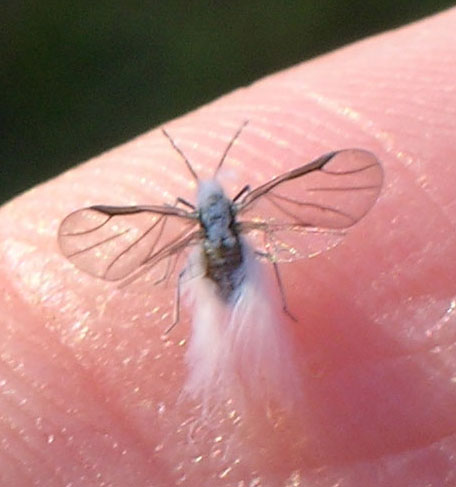
Walking back, I noticed a very small but conspicuously heavy-flying periwinkle insect. It was easy to catch with a quick grab. A wooly aphid (family Eriosomatidae)! My first! The posterior boasts a bouquet of "feathers", apparently wax, which you can see here. One blogger referrs to them affectionately as her little "fairy flies" -- that is, before learning of their taxonomy as a relative of (garden) aphids, her arch enemy. Wooly aphids, however, are apparently more pestiferous of trees. I don't have a garden...or any trees. And I needed to be romanced. So this one's fuzzy butt was most welcome in my palm. A great way to end the outing.

Tuesday, November 4, 2008

Presidential Election 2008


Congratulations, America!

Regardless of who you voted for, the waiting is over. Here at the Veggy House , and like so many other places, people gathered to welcome the election results. There was wine and snacks, champagne and toasting. But it was subdued, with little of the cheering and whooping I'd imagined. Our gathering of twenty plus was a gorgeous cornucopia of skin colors from white, to olive, brown and black, including ages two to...much-older. There were tenants, neighbors, friends and guests, each one fell solemn during Obama's acceptance speech as we absorbed the levity of the election finally over, the implications of the history being made, the weight of the work ahead. Finally...hope! I found it interesting that those from other countries (there were several) expressed as much joy over the outcome as anyone.

For some, like myself, it's been eight years coming. To avoid the suffocation of irrevocable disappointment, I've been living underground when it comes to national politics, surviving my scorn and America's descent in, well, just about every way possible. Lamenting -- at times fearing -- our country's declining reputation by others around the world in a way that is unprecedented for my generation. Feeling bitter over not being heard, over my neighbors not being heard. Watching the few (who cut corners) rise at the expense of the many who don't. I'm too young to be jaded! My panacea has come from volunteering for causes I consider solution-focused, and reframing my hope in this country through the power of communities and local politics -- both values I learned in AmeriCorps. But finally...today I exhaled. Aahhhhh. Deep and full, awkward and unfamiliar. Eight years coming. The jeering and whooping can wait, I don't mind. Tonight and for many to come, I fall asleep feeling...re-enchanted!

Monday, October 6, 2008

Bugless in Corvallis

HOLY CRAP! Graduate school is really crazy. I'm on borrowed seconds just being here! In fact, amidst the TON of reading, meetings, fixing a crashed (yet new) computer, classes, new-hire logistics, and studying, I have yet to molest any insects.

Check that. Yesterday, while passing in front of Cordley Hall, I found a yellow jacket nest on the sidewalk (Vespula or Dolichovespula are the genera). As large as a watermelon and lighter than a dinner plate, the pliable nest boasted a concentric pattern of tan and dark brown woven into layers, like a croissant. Exquisitely beautiful. The pliable pulp usually doesn't last the winter, unfortunately, and tends to break down. Queens overwinter, other adults typically die.

I lifted the top off like a tupee to view five or six tiers of larval chambers inside, which looked a lot like stacks of honeycomb without the honey. Several lovely ladies, chilled and slow-moving, sat unmoved. We go way back, they and I. Lots of stingings during lots of wildlife jobs. They are all-powerful, and can even make grown men scream like a woman, swatting and running, crashing haphazardly through forests, abandoning all sense and decorum (not to mention expensive equipment). One turned from her protective perch on the top tier to face me. Our eyes met, and I swear she growled.

I wanted to take the nest home, freeze it/them, and use it for decor... But instead I placed it beneath the benevolent bows of a nearby Western red cedar and covered it with loose leaves and branches. Who knows, maybe they'll survive the winter if they stay warm and dry. After five years in the low desert, it's nice to see some of my old friends again. :)

Thursday, September 18, 2008

Roadtrip Home

I made it to my new home in Oregon! The car, the kitties, my stuff... This move back to the greater PacNW is permanent, and I cannot express how glad I am for that. Never, ever will I ever move cross country again (so much for being a hobo). Bone China and other such goodies from grandmas, etc., are lovely keepsakes which I'm very glad to have. But there were times during this move when I truly questioned whether moving things was worth all the stress. It was! But I wouldn't do it again!

Here's a video I put together with some of my favorite people/memories in Arizona followed by a few pix of the move...


Music: Ellis Paul, "Roadtrip"


My home in Corvallis is awesome! I live in a big beautiful "vegetarian house" just one block from campus. It's a converted fraternity house. In fact, we're surrounded by frats and sororities, so real-life episodes of Gossip Girl and the OC are played out each evening on the sidewalks and yards, and waft in through my open windows during these last warm and lazy days of summer. It's humorous. But it's altogether impossible to be frustrated by this or any other distraction because the neighborhood is just beautiful. The trees are nothing short of glorious, and dwarf even the largest of homes. My room is similarly voluminous, with a fireplace and two windows on the second floor. But the best part of living in the veggy house, the part anyone like me coming from Phoenix could appreciate, are the people. They range from two years old to over sixty. Composters, bicyclers, community activitists, AmeriCorps members (a kindred spirit there), oceanography students, retirees, you name it. It is the quintessential cornucopia of the best of the Pacific Northwest. And I get to call them housemates, each one.

After this week's orientation and other logistical tidbits get tied up this week, I'll dive into the bug stuff once again. For that I can hardly wait. I also plan to find at least one of the more than 25 species of scorpions that live in the Northwest -- none of which I or anyone I know has ever seen.

I'm sorry to say my plans to experience a scorpion sting were smartly abandoned. A lot -- I mean a LOT -- of kooky things popped up over the past 8 weeks while gearing up for this move. At one point I was even poisoned by some structural "upgrades" at my apt resulting in an emergency room visit and temporarily having to move out. Flukey, eh? Inconvenient, to say the least. As other major things also began to go awry, I decided not to tempt fate with a bark scorpion sting; with my luck it would have induced a RARE allergic reaction or some such.